
Why Patients Avoid Costly Physical Therapy Bills
Physical Therapy, Healthcare Costs, Cash-Based Practice
$1,100 for a Physical Therapy Treatment? Why Patients Are Walking Away
Patients aren’t quitting physical therapy because they’re lazy or don’t care about their health. They’re quitting because of enormous, unpredictable bills that show up weeks later and blow up their budget. And sometimes, those bills are for more than $1,100 for a single visit.
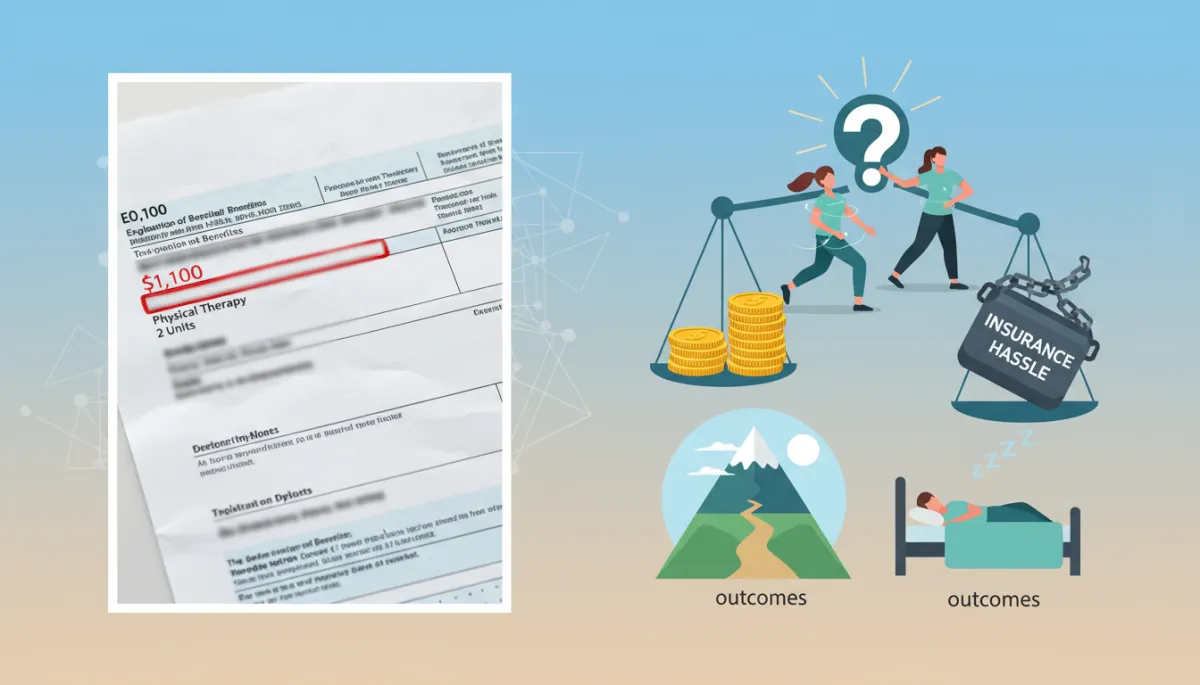
An actual Explanation of Benefits showing more than $1,100 billed for just two units of physical therapy.
The Day a Patient Brought Me a $1,100 Bill
Years ago, a patient walked into my clinic holding an Explanation of Benefits like it was a summons to court. She’d gone to an in-network physical therapy clinic after surgery, did everything “right,” and then opened a letter that said she owed more than $1,100 for one visit.
Two units of physical therapy. Over a thousand dollars billed. Her portion? Hundreds of dollars out of pocket… for a single session where she spent most of the time on a table doing exercises she could have done at home with a handout.
"Patients don't quit physical therapy because they don't want to get better. They quit because the financial system makes it impossible."
She wasn’t angry at physical therapy. She was angry at a system that turned basic rehab into a luxury purchase. And she’s not alone. Across the country, people are dropping out of care early, not because they don’t value it, but because healthcare pricing is broken.
Sticker Shock: What PT Really Costs in 2026
Let’s zoom out from that $1,100 bill and look at where physical therapy prices are today. In 2026, a typical one-hour physical therapy session in the U.S. runs somewhere between $75 and $150 if you’re paying out of pocket. Initial evaluations can climb to $150–$400, and hospital-based visits can be even higher, sometimes $300–$400 for follow-ups alone, according to recent cost analyses from Forbes and other healthcare cost trackers.
If you use insurance, you might think you’re protected. But most people still end up paying $20–$60 per session in copays or coinsurance, and a standard 10–12 visit plan of care can easily total $1,000–$2,000 out of pocket before you’ve even met your deductible. For many families, that’s the difference between getting better and just “living with it.”
Insurance doesn’t erase the bill. It just hides it—until the statement shows up with your name on it.
The Real Problem: A Broken Pricing System, Not “Expensive PT”
When patients see a bill like $1,100 for a single treatment, it’s easy to think, “Physical therapy is way too expensive.” But that’s not the full story. The problem isn’t the care itself—it’s how it’s priced, billed, and paid for inside the insurance system.
Hospitals and large clinics often bill per “unit” of time or per procedure code. A 15-minute unit of therapeutic exercise might be billed at over $60–$70, even though Medicare reimburses around $29 for that same code. Add in multiple units, facility fees, and evaluation codes, and suddenly that short visit becomes a four-figure bill on paper—before your insurance company even decides what they’ll cover.
Patients aren’t refusing care because they don’t value walking without pain or lifting their kids. They’re refusing care because the rules of the game are rigged against them. They’re tired of:
Surprise bills weeks after a visit
Not knowing what anything will cost upfront
Being told one thing by their insurance and billed something completely different
The system is confusing by design. Confused patients pay more and question less.
Cash-Based PT Isn’t Expensive. It’s Honest.
Here’s where most people are shocked: in today’s world of high deductibles, paying cash for physical therapy often costs less than using your insurance. Especially if you haven’t met your deductible yet, you’re paying the full contracted rate anyway—just with more steps and less clarity.
A typical cash-based PT session today might run $150–$250 in many markets. That’s often for a full hour of one-on-one care with a specialist who isn’t juggling three patients at once. No facility fee. No mystery codes. No surprise “your insurance changed its mind” letter next month. Just transparent, predictable pricing.
And because there’s no insurance middleman, cash practices are forced to compete on things that actually matter to patients:
Value: “What do I get for my time and money?”
Time: “How much one-on-one attention will I actually receive?”
Results: “How quickly can I get back to what I love doing?”
Transparency: “Do I know the price before I say yes?”
Cash-based physical therapy isn’t a luxury product. It’s a transparent alternative to a system that hides the real cost of care.
The Wrong First Question: “Do You Take My Insurance?”
If you’re a physical therapist, you’ve heard this question a thousand times: “Do you take my insurance?”
It sounds reasonable. People are trying to be responsible. They’re scared of big bills. But it’s the worst possible place to start the conversation, because it assumes that:
Insurance automatically makes care cheaper (it doesn’t always)
All physical therapy is the same (it absolutely is not)
Therapists need to learn how to gently redirect this question. Instead of leading with insurance, lead with the patient’s goals.
Redirecting the Conversation to What Really Matters
When someone calls and asks, “Do you take my insurance?” try responding with something like:
“That’s a great question, and we’ll definitely talk about cost. Before we do, can I ask—what’s going on, and what are you hoping physical therapy will help you do again?”
Now you’re having a different conversation. You’re talking about their outcomes, not your billing codes. You’re talking about:
Hiking pain-free on the weekends
Sleeping through the night without shoulder pain waking them up
Picking up their grandkids without fear
Patients don’t buy procedures. They buy outcomes. They’re not paying for “97110 x 2 units.” They’re paying to get their life back.
Once the outcome is clear, the investment makes more sense. “It will take about eight visits to get you back to hiking without knee pain. Each visit is $200, and we’ll give you a clear plan so you know exactly what to expect.” That’s a very different feeling than, “We’ll bill your insurance and see what happens.”
Why This Matters More Than Ever in 2026
The old model—“Just use your insurance, it’ll be cheaper”—doesn’t match reality anymore. Here’s what patients are dealing with right now:
Rising deductibles: Many plans have $3,000–$7,000 deductibles. Until that’s met, patients are effectively cash-pay at inflated insurance rates.
More patient responsibility: Coinsurance, copays, and “out-of-network” surprises mean people shoulder more of the bill than ever.
Insurance frustration: Authorizations, visit limits, denials, and endless phone trees wear people down before they even start care.
Demand for transparency: New price transparency rules and digital tools are training patients to expect real numbers before they say yes.
All of this is fueling the growth of cash-based healthcare across the board—physical therapy, chiropractic, primary care, even surgery in some markets. People are realizing that paying directly for high-quality, transparent care often beats gambling on what their insurance will decide to cover.
The future of healthcare isn’t “free with insurance.” It’s clear, direct, and outcome-focused—whether insurance is involved or not.
The Hard Truth: Insurance Can Make Care More Expensive
This is the part no one on your insurance card wants you to think about: Insurance doesn’t automatically make healthcare affordable. In many situations, especially with high deductibles, it actually makes care more expensive.
When a hospital bills $1,100 for a visit and your insurance “negotiates” it down, you might still be responsible for hundreds of dollars. If you haven’t met your deductible, you’re paying the full contracted rate anyway—often far more than a local cash-based PT would charge for better, more personalized care.
Insurance is a payment method, not a quality guarantee and not a discount card.
As healthcare providers, our job isn’t to push people toward whatever option looks cheapest on the surface. Our job is to help patients make informed decisions—to show them:
What their likely total cost will be with insurance versus cash
How many visits they’ll probably need to reach their goals
What kind of experience and outcomes they can expect in each setting
When patients understand that, many of them willingly choose to invest in direct-pay, one-on-one care—because they see the real value, not just the line item on their insurance card.
So, What Do We Do About $1,100 PT Bills?
If you’re a patient, you don’t have to accept a system that surprises you with four-figure bills for basic rehab. You can:
Ask for prices before you schedule
Compare in-network hospital clinics with independent and cash-based practices
Choose providers who talk clearly about outcomes and total cost, not just “coverage”
If you’re a therapist or practice owner, you can stop hiding behind “we take your insurance” and start leading with the results you deliver, the time you give, and the clarity you provide.
Insurance doesn’t make healthcare affordable. In many cases, it makes it more complicated, more confusing, and more expensive.
The path forward is simple, but not always easy: be transparent, focus on outcomes, and give patients real choices. When people understand what they’re paying for—and what they’re getting in return—they’re far more likely to stick with care, finish their plan, and actually get better.
Your Turn: Let’s Talk About the Biggest Bill You’ve Seen
I started this conversation with a $1,100 bill for two units of physical therapy. Sadly, that’s not even the worst I’ve seen since then. But I’d love to hear from you:
What’s the largest physical therapy bill you’ve ever seen—or received? Drop it in the comments, and let’s keep exposing how this system really works so we can build something better.
Want More Cash-Paying Patients?
If you’re a practice owner who’s tired of playing the insurance game—chasing authorizations, writing notes for auditors instead of patients, and hoping the next reimbursement cut doesn’t wipe out your margin—it’s time to build a different kind of business.
I help physical therapists create profitable, cash-based and hybrid practices that attract patients who are happy to pay out of pocket for great care. You’ll learn how to:
Attract more cash-paying patients without relying on physician referrals
Charge what your time and expertise are actually worth
Build a practice that supports your life instead of burning you out
Ready to step off the insurance treadmill and grow a practice you’re proud of? Visit https://aaronlebauer.com to get started.